
When to Use a Three-Head Cutting Saw for Aluminum Profiles
Evaluate a three-head aluminum profile saw using actual cut lists, head sequences, finished dimensions and accepted kits per hour.
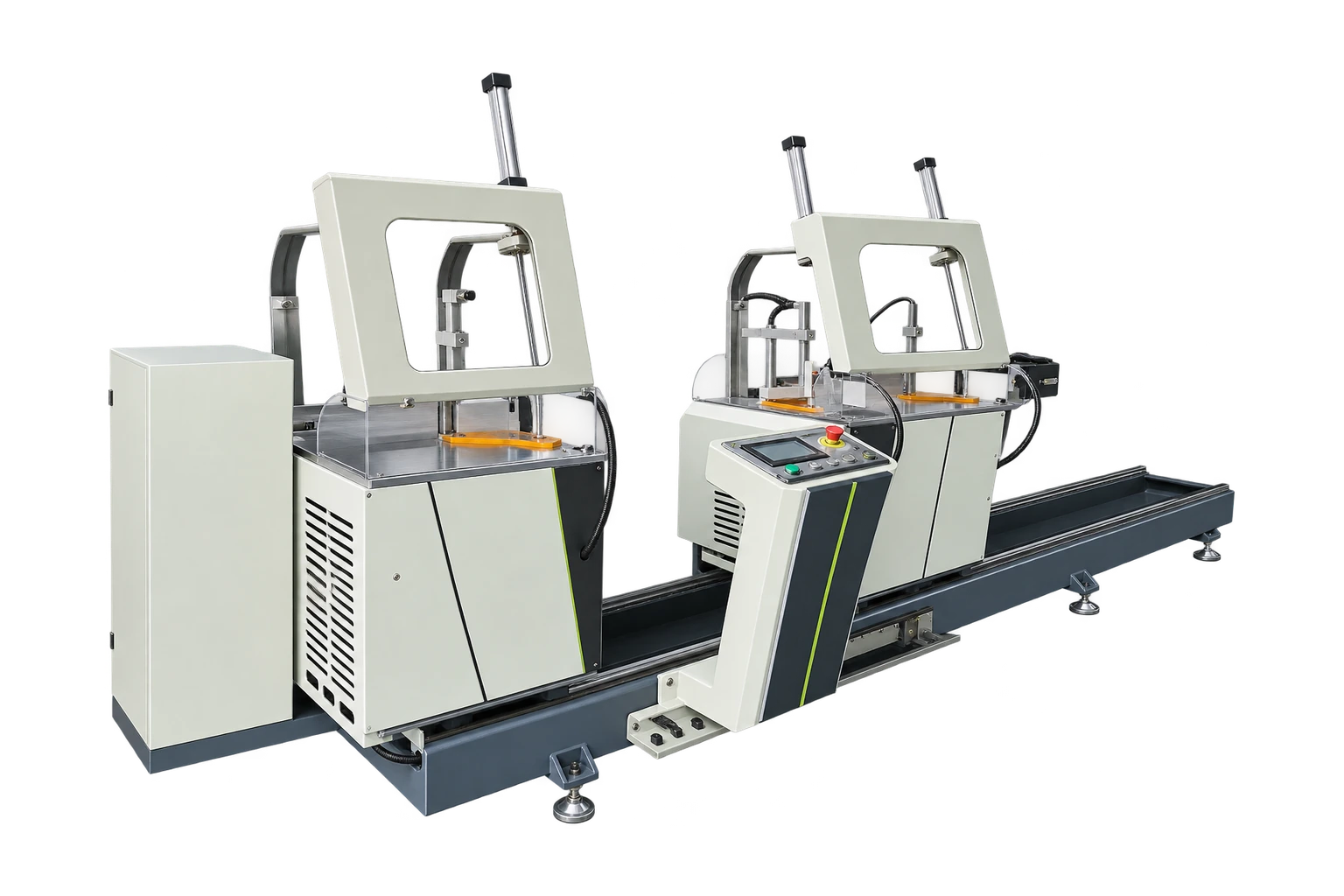
When is a three-head cutting saw useful?
A three-head cutting saw for aluminum profiles is worth evaluating when your repeat orders regularly combine mitred frame members and square-cut members, and the third head can replace an actual move, reload or stop change in your current workflow. Start by mapping your cut list to the proposed heads. If most of your production consists of identical two-end mitres and the third head sits idle, a double-head saw may be the more straightforward comparison.
Head count alone does not establish the cut sequence. One published configuration from MCS CNC uses two 45-degree heads and one 90-degree head for sliding-door and profile work. Treat that as an industry example. Ask Jinren for the actual head arrangement, motion and control sequence of the machine being quoted, including which heads can run in the same cycle.
Separate the production orders by actual cut pattern
Take several representative orders from the same production period. For every line, record the extrusion code and finish, finished length, left and right end angles, quantity and required length reference. Put handed pieces on separate lines. Mark whether the part goes directly to assembly or needs end milling, drainage slots or hardware holes afterward. The objective is to see where the extra head changes the path of a specific part.
| Order pattern | Test on a three-head saw | Comparison baseline |
|---|---|---|
| Repeated frame kits with mitred rails and square-cut members | Verify the approved head sequence and count how many times stock is moved and re-referenced. | Time the same kit through a double-head saw plus the existing square-cut operation. |
| Mostly matching mitred rails and stiles | Observe whether the third head performs any work on the selected order. | Compare accepted parts and changeover time on the two-head workflow. |
| Short or asymmetric parts | Run the shortest finished member and the widest asymmetric section in their real seating orientations. | Compare supported clamping length, surface marks and end dimensions. |
| Members that need secondary machining | Label each finished part and verify that the next machine can locate from the same drawing datum. | Count rehandling, queues and any extra inspection between operations. |
Read the cutting envelope before comparing output
Ask for the cutting diagram for each head and orientation. The largest section that fits a square cut may not fit at a mitre angle, and a short finished piece may require a particular approved support arrangement. The elumatec DG 104 documentation is a useful example of a double-head saw technical sheet that separates the cutting diagram from the headline length and lists support and clamping options. Use the same level of detail when reviewing the three-head quote.
Give the supplier one drawing that labels the long-point and short-point references explicitly. Have the operator enter that line into the control and show which dimension the program expects. Inspect the retained piece at both ends. This catches a reference mismatch that can otherwise produce a part with the right angle and the wrong installed length. Use the approved operating and guarding procedure for all trial cuts.
Measure a complete kit, including the parts that fail
Prepare the same production stock and cut list for both workflows. Record elapsed time from the first loading action to the last accepted kit. Include angle changes, part identification, inspection and rework. Track setup time separately if programs and stops are prepared before the timed trial. A kit only counts when all its required members are present and accepted.
For illustration, a trial with 10 accepted kits in 50 minutes yields 12 accepted kits per hour. That arithmetic is a method for comparing trials, not a machine rating. If an extra head reduces reloads but introduces a longer changeover, repeat the trial with your normal batch size. Dry assemble at least one representative frame, then check diagonals and corner seating to the project drawing. Record the profile, supports, head sequence and measurement references so the result is repeatable.
What to send for a Jinren comparison
Send three cut lists: a typical mixed-angle order, a short-member order and a large-section order. Include section drawings and photos of your current supports if available. Ask the supplier to mark which head performs each cut, any manual moves, required options and which operations remain downstream. Start with the Jinren three-head aluminum profile cutting saw and use the outward versus inward double-head saw guide to build the comparison baseline.
Send your cut list for a trial review.
Manufacturer references
- MCS CNC equipment catalogue, three-head sliding-door saw configuration example.
- elumatec DG 104 technical sheet, double-head cutting diagram and support options.