
Outward-Swing vs. Inward-Swing Double-Head Saws for Aluminum Profiles
Compare outward- and inward-swing double-head saws using cutting diagrams, profile support, mitre references and a production sample trial.
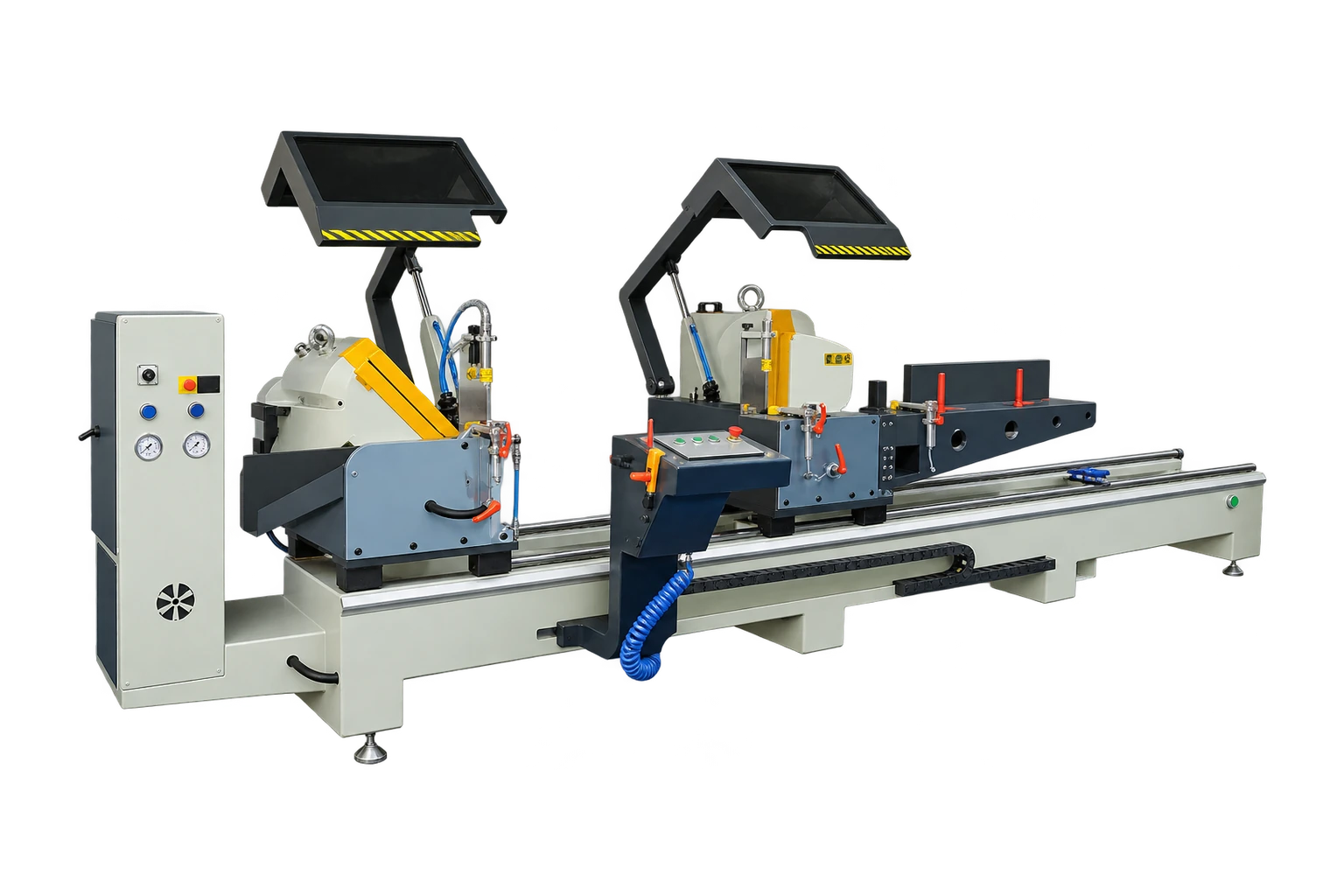
Which head movement suits your frame parts?
Choose an outward-swing double head saw for aluminum profiles when its cutting diagram, clamping arrangement and control can reproduce the required cuts on your actual sections. An inward-swing configuration can be equally suitable for parts that fit its envelope. For a fabrication buyer, the deciding evidence is a set of accepted rails and stiles measured from the specified reference, followed by a dry-fit of the frame.
Ask the supplier to distinguish pivoting in the plane of the machine bed from blade tilting out of that plane. Some manufacturers also use internal and external to describe the cut orientation. Angle scales can use different zero points. Ask for a sketch showing the blade plane, fence, profile orientation, angle reference and retained part on each head. Do this before comparing two advertised angle ranges.
Read the cutting diagram with the extrusion drawing beside it
Lay the largest profile section over the diagram for the required angle and orientation. A blade diameter or a headline capacity cannot establish whether the part clears a guard, a clamp and the blade path at a particular angle. Check the shortest finished member as well. When the heads are close together, the safe clamping area and retained part support can differ from a long-stock cut. Ask about approved support blocks, short stops and outfeed support if the proposed setup needs them.
| Drawing condition | What to ask the supplier to prove |
|---|---|
| Deep frame section at a 45-degree mitre | Show the permitted cutting envelope at the actual angle and seating orientation. Demonstrate a clean cut on the full section. |
| Short sash member | Show the minimum finished length with the selected head position, stop and clamp arrangement. |
| Mixed angles or handed sections | Show how left and right orientations are programmed and how the operator checks the first piece after an angle change. |
| Long flexible extrusion | Show how infeed and outfeed support keep the extrusion seated at both heads without twisting the section. |
Why two catalogue angles can describe different cuts
Emmegi's Precision TS2 specification lists separate internal and external head inclination limits. The elumatec DG 244 technical sheet documents pivoting and tilting separately, and directs buyers to its cutting diagram for the usable section range. These are examples of how manufacturers define their own axes and envelopes. Their values apply to those machines and are not Jinren specifications.
Keep long-point and short-point dimensions consistent
Put a dimension arrow on the frame drawing rather than relying on a description such as outside length. Specify whether the target is measured between the outer long points, inner short points, or another defined reference face. Enter one sample in the supplier's control, then compare the cut piece to the drawing at both ends. Verify which reference the machine used, especially when a profile is flipped or a rail is cut from the opposite orientation.
For example, if the drawing calls for an outside long-point dimension and the controller is set to an inside reference, a good angle can still produce a member with the wrong length. When the pair closes at one edge but opens at the other, inspect the angle and burrs. When the rails and stiles are individually correct but the frame diagonals differ, check seating, corner connection and assembly conditions before adjusting saw offsets. Use the project drawing for the allowed values.
Run a representative saw acceptance trial
- Bring the widest section, the shortest finished part and a long part that needs extra support. Include the production finish so clamp marks can be evaluated.
- Cut left and right members at the required angles using the maker's approved operating and guarding procedures. Record the support and clamp configuration with each sample.
- Measure finished length at the nominated reference and check angle, burrs and visible finish. Repeat after a real changeover, rather than inspecting only the first setup.
- Dry assemble a full frame with its specified connectors. Compare the diagonals, corner gaps and alignment against the drawing.
- Record the time from loading to accepted parts, including checks and changeovers. If profiles also need holes and slots, compare the complete saw-plus-machining workflow with a combined station.
What to request from Jinren
Send the profile cross sections, cut list with angle conventions, shortest and longest part lengths, and a finished-frame drawing. Ask for a configuration-specific cutting diagram and a trial on your hardest section. Start with the Jinren outward-swing double-head saw and compare the combined sawing and milling machine if the same parts need machining after cutting. See the general double-head saw selection guide for the broader buying checklist.
Send your cut list and profile drawings for review.
Manufacturer references
- Emmegi Precision TS2 specification for internal and external inclination terminology.
- elumatec DG 244 technical sheet for distinct pivot and tilt specifications and the cutting diagram.